The CRO Framework Behind 6–7% Conversion Rates
.png)
The CRO Framework behind 6-7% Conversion Rates
Most DTC brands waste thousands on CRO testing button colors while their customers can't even find the products they want to buy. Ashna's framework reveals the one test type that drives the highest ROI for multi-product brands, plus exactly how to diagnose where your funnel is actually broken.
I recently sat down with Ashna, one of the top conversion rate and experimentation specialists in ecommerce. She's led CRO programs for brands like Ritual, Manukora, and Kolkata Chai over the last seven years, now working with brands through the Storetasker network.
When Ashna talks about her approach, it's refreshingly practical. She starts with a simple question: can your customers actually find what they're looking for? Because if they can't, nothing else you test will matter.
Early Stage: Finding Product-Market Fit
When you're doing your first hundred thousand to a few million in revenue, you're not worried about whether a button should be purple or blue. You're testing things like: does anyone actually want this product at this price? Does the way we're explaining the value proposition resonate? Are we targeting the right customer segment?
The "tests" here might not even be formal A/B tests with statistical significance. They might be launching different landing pages for different campaigns and seeing which performs better. They might be trying completely different offers and measuring the response.
This is about learning fast and iterating, not about incremental gains.
Mid Stage: Optimizing the Funnel
Once you're in the fifteen to twenty million range, you have product-market fit. You know people want what you're selling. Now the question becomes: how do we remove friction and increase the percentage of visitors who convert?
This is where traditional CRO starts to make sense. You're testing navigation structures. You're optimizing content on product pages. You're improving the cart and checkout experience. You're running formal experiments with proper sample sizes and statistical significance.
You have enough traffic to get meaningful results from tests in a reasonable timeframe. You have enough baseline performance to know what "good" looks like. You can start making incremental improvements that compound over time.
The key here is prioritization. There are hundreds of things you could test. The skill is knowing which tests will have the biggest impact and focusing there first.
looking for a specific type of product and can't figure out how to get there, they bounce.
For example: Ashna has seen massive gains from navigation testing on both desktop and mobile. This includes:
- The structure of your main navigation menu. Are you organizing by product type, by use case, by customer segment? What makes the most intuitive sense for how your customers think about your products?
- Mobile navigation specifically. Most traffic is mobile now, and mobile navigation is fundamentally different from desktop. Testing things like category images, expandable dropdowns, and different menu structures can have huge impact.
- Search functionality and logic. If someone uses your site search, they have high intent. Making sure search returns relevant results and guides people to the right products is critical.
- Product collection pages. What products are you showing? How are they organized? What filters are available? This is where people browse and discover, so optimizing this experience matters.
For the more typical DTC brand with one hero product and maybe a few variants or formats, your situation is different. Navigation doesn't matter much because there's not much to navigate to. Your leverage is in content.
For those brands, the problem Ashna sees constantly is that brands bury their best content. They have incredible information about why their product works, how it's different, what problems it solves. But they hide it in expandable FAQ sections or down at the bottom of the page where nobody sees it.
The opportunity is pulling that content up and testing different ways to showcase it prominently. This might mean:
- Bringing key selling points into the hero section of your homepage or product page instead of hiding them below the fold.
- Pulling information out of FAQs and turning it into visual content blocks that are immediately visible.
- Testing different ways to present your core value proposition so it hits harder and faster.
The process for this starts with research, not design. Ashna looks at post-purchase surveys and customer feedback to understand why people buy and why they don't buy. What are the key reasons that tip people over the edge? What are the common objections or concerns?
Once you know that, you test different ways to surface that information more prominently across your homepage, collection pages, product pages, and cart. The goal is persuading customers why they should choose you over an Amazon purchase or a competitor.
For brands where education is critical to conversion, this content work often has more impact than any other type of testing.
Large Scale: Profit Maximization
When you're doing fifty, seventy five, one hundred million plus, you're not worried about basic conversion optimization anymore. Your funnel is already pretty tight. The question becomes: how do we maximize profit per customer while maintaining or growing volume?
This is where brands like Ritual and Seed focus. They're not testing button colors. They're testing price points, shipping thresholds, subscription versus one-time purchase mix, bundling strategies, and other levers that directly impact unit economics.
Ashna describes this stage as being about strategic positioning in a changing market. These brands have seen multiple cycles of the DTC era. They understand their customers deeply. They're making calculated bets about how to structure their offers to maximize long-term profitability.
The testing here is more about answering strategic questions than tactical optimizations. Should we go back to subscription-only? Should we adjust our price point to account for increased CAC? Should we bundle products differently to increase AOV?
Offer Testing for Mature Brands
Once you've optimized navigation and content, or if you're at a scale where those aren't your primary levers anymore, offer testing becomes the focus.
This is what Ashna does with brands like Ritual. They're not testing whether to add a trust badge or change headline copy. They're testing fundamental questions about their business model:
- What price point maximizes profit per customer while maintaining acceptable conversion rates?
- Should we include free shipping or charge for shipping? At what threshold?
- Should we push subscription versus one-time purchase? How do we structure that choice?
- What product bundles or configurations drive the best combination of conversion rate and AOV?
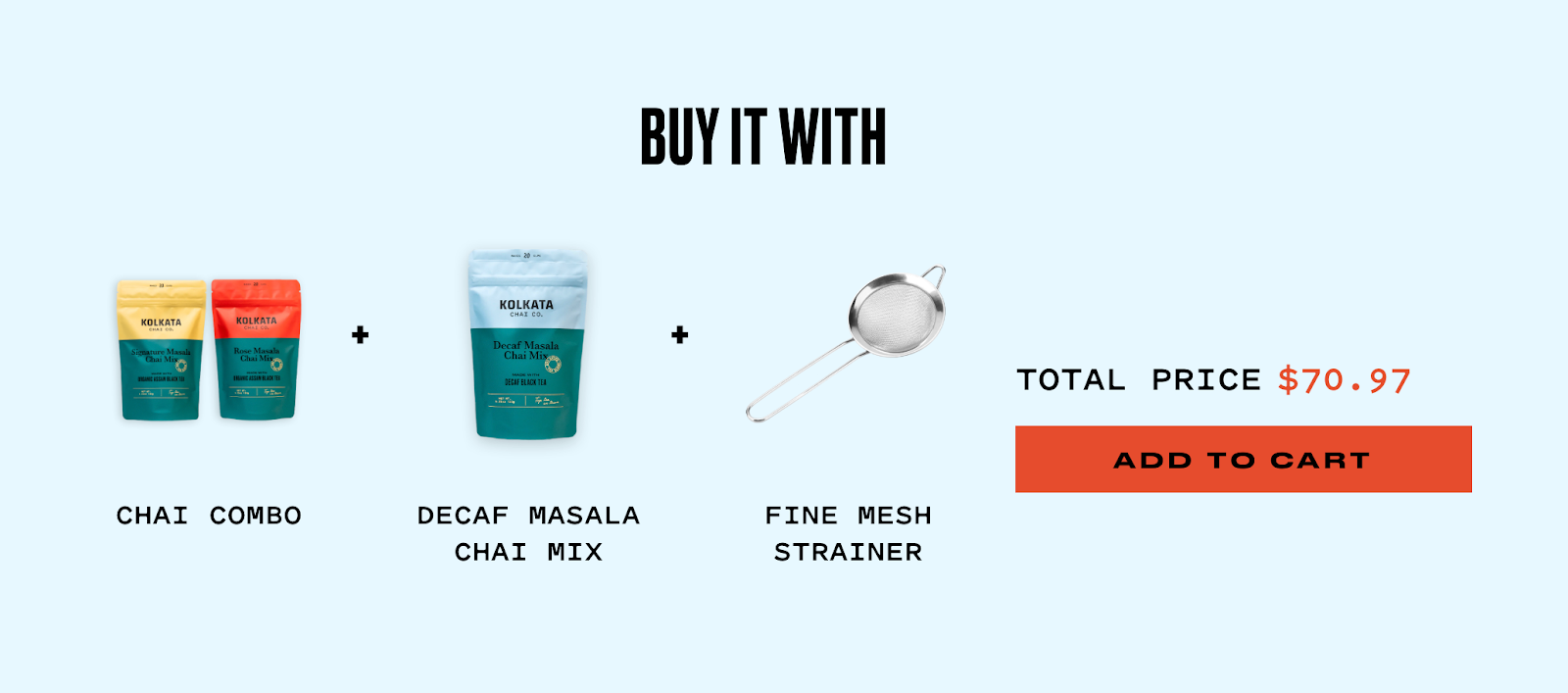
Ashna specifically calls out Kolkata Chai as an example of offer testing driving major growth. They created a two-pack masala chai mix that functioned as a starter kit with everything someone needs to make their first cup. That specific offer configuration became the foundation for their growth over the following years.
The principle: if you can include free products and adjust pricing to compensate, while showing remarkable value to customers, that often drives conversion rate increases that more than make up for any AOV decrease.
This is strategic work, not tactical optimization. You're testing different ways to structure your core business model.
Tools for Price and offer testing
The go-to tool for price and shipping testing is Intelligems. Ashna specifically calls them out as comprehensive with incredible support. You can use them for testing price, shipping thresholds, and offer configurations.
The advantage of Intelligems over trying to set up price tests manually is that they handle all the complexity. Different pricing for different visitors, proper tracking, clean data, and managing the technical setup that would otherwise require significant development work.
For brands serious about price testing, it's worth the investment in the right tool rather than trying to hack together a solution.
Conversion Rate Benchmarks & Compounding insights
Everyone wants to know: what's a good conversion rate? Ashna's answer is more nuanced than a single number because it depends entirely on your AOV and business model.
The AOV Relationship
If you're a CPG brand with an AOV around $50, your website conversion rate should be somewhere between four and six percent minimum. Ideally you're pushing seven, eight, or nine percent. If you're below four percent, that's a critical red flag and you need to be looking hard at your website.
As AOV increases, the conversion rate typically decreases but you can still be highly profitable. If your AOV is $100 to $200, getting to three to four percent is really healthy. Below three percent should trigger alarms.
The reason is unit economics. These two numbers have to work together to make your business model profitable. You can't just look at conversion rate in isolation and declare it good or bad.
A brand with a $50 AOV and a two percent conversion rate has a problem. A brand with a $200 AOV and a three percent conversion rate might be printing money.
The Subscription Dimension
For subscription brands, the calculation is even more complex. You might actually want a slightly lower conversion rate on subscription signups if it means you're acquiring customers who stick around longer.
Ashna points out that conversion rate and LTV need to be looked at together. You can have a really high conversion rate where customers are dropping off after the first month, and you're still operating in the red because you acquired customers at a one-month payback but they cancelled before you recovered CAC.
In that scenario, it might be better to have a lower conversion rate but acquire customers who stay through months four and five at a higher rate. The total economics work out better even though the surface-level conversion rate looks worse.
This is why you can't just copy someone else's benchmarks. You need to understand what conversion rate makes sense for your specific business model, your CAC, your margins, and your retention curves.
The Long-Term Compounding Effect
One final point that Ashna makes: CRO is not about one-time wins. It's about building a system of continuous improvement that compounds over time.
A brand that improves conversion rate from four percent to five percent has increased revenue by 25% from the same traffic. If they then improve from five percent to six percent, that's another 20% increase. These improvements compound.
But it only works if you're systematic about it. Identify opportunities, test solutions, implement winners, move to the next opportunity, and revisit areas as your business evolves.
Brands like Kolkata Chai hitting six to seven percent conversion rates didn't get there with one magic test. They got there through years of continuous optimization, always looking for the next area to improve while maintaining the wins they've already achieved.
That's what separates brands that actually scale profitably from brands that plateau and can't figure out why. The ones that scale have systems for continuous improvement. The ones that plateau stop optimizing once they hit some arbitrary target.
The brands that win long-term are the ones that treat CRO as a core competency, not a one-time project.
Need help building a systematic CRO program that actually drives results? Connect with Storetasker's conversion optimization experts who specialize in diagnosing friction and implementing tests that move the needle.


Shopify Expert?


.svg)


.svg)
